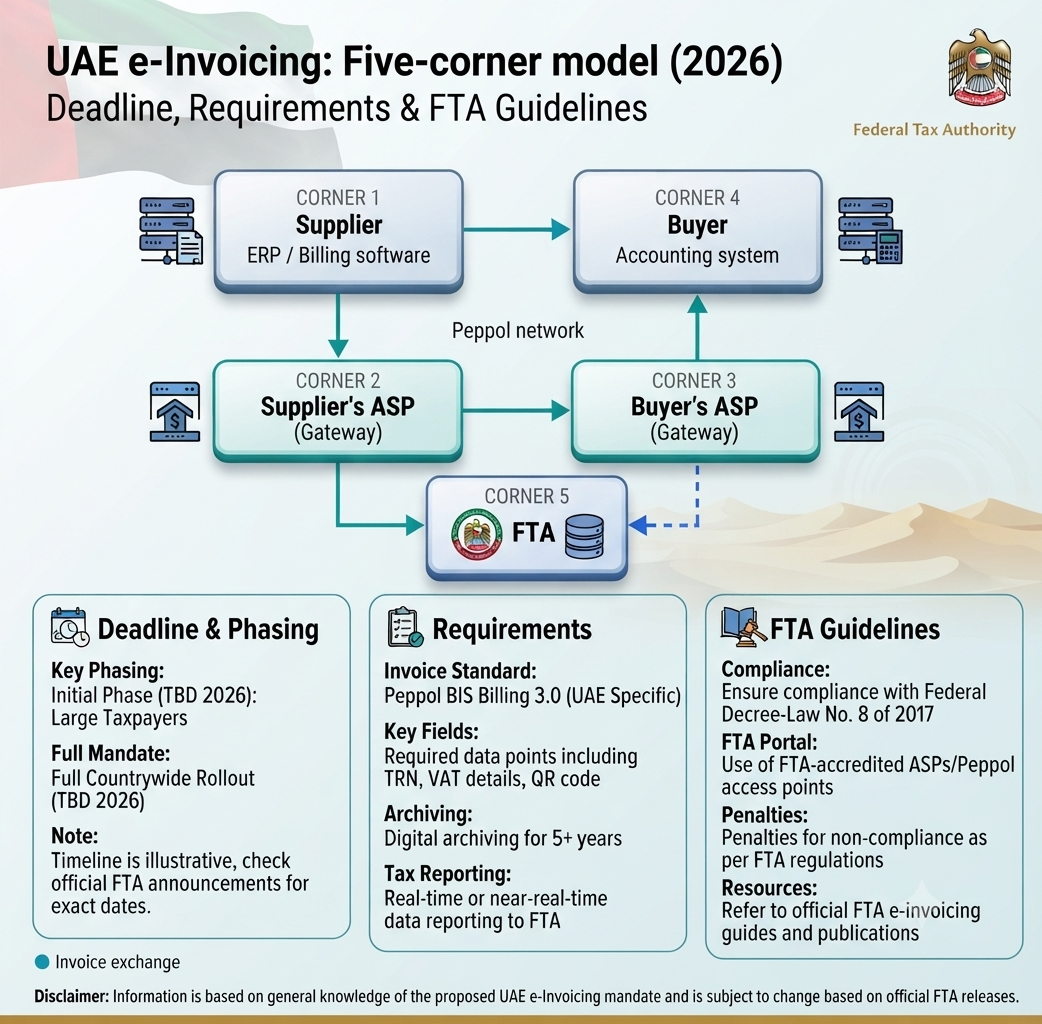
The United Arab Emirates is transforming its tax and financial reporting system through the introduction of mandatory electronic invoicing. The new UAE e-invoicing system aims to improve tax transparency, automate invoice processing, reduce compliance risks and simplify business transactions.
Under the framework introduced by the Ministry of Finance (MoF) and the Federal Tax Authority (FTA), businesses must generate, exchange and report structured electronic invoices through Accredited Service Providers (ASPs).
The UAE e-invoicing pilot programme commenced on 1 July 2026, with mandatory implementation beginning on 1 January 2027 for businesses with annual revenue of AED 50 million or more.
Whether you operate a small business, multinational enterprise or government organisation in Dubai, Abu Dhabi, Sharjah or elsewhere in the Emirates, understanding the UAE e-invoicing requirements is essential to preparing for compliance.
This guide explains the implementation deadlines, mandatory invoice requirements, FTA guidelines, exemptions, penalties and practical steps businesses should take before the mandate becomes applicable.
UAE e-Invoicing 2026: Key highlights
-
The pilot programme commenced on 1 July 2026.
-
Mandatory implementation begins on 1 January 2027 for large businesses.
-
Businesses earning below AED 50 million must implement the system by 1 July 2027.
-
The mandate primarily covers B2B and B2G transactions.
-
PDF, Excel and scanned invoices alone do not qualify as electronic invoices.
-
Businesses must appoint a Ministry of Finance-accredited service provider.
-
Certain non-compliance penalties can reach AED 50,000 within 12 consecutive months.
What is e-Invoicing in the UAE?
Electronic invoicing, commonly known as e-invoicing, is the process of creating, transmitting, receiving and processing invoices in a standardised, machine-readable electronic format.
Unlike traditional invoicing, where businesses send paper invoices or PDF documents through email, the UAE Electronic Invoicing System enables automated invoice exchange between suppliers and customers while reporting prescribed tax information to the Federal Tax Authority.
The system uses the Peppol-based PINT-AE standard, enabling different accounting platforms, ERP systems and invoicing applications to exchange invoice information.
The main objectives of introducing electronic invoicing in the UAE include improving VAT compliance, reducing manual data entry, strengthening financial transparency, minimising invoice fraud and supporting the country's digital economy.
UAE e-Invoicing deadline and implementation timeline 2026–2027
The UAE government has adopted a phased implementation approach based on business revenue and entity type.
According to Ministerial Decision No. 244 of 2025 and its amendment under Ministerial Decision No. 66 of 2026, the following deadlines apply.
UAE e-Invoicing implementation roadmap
2026–2027 compliance timeline
-
1 July 2026
Pilot programme and voluntary adoption begin.
Completed milestone -
30 October 2026
ASP appointment deadline for businesses with revenue of AED 50 million or more.
Deadline passed -
1 January 2027
Mandatory implementation for large businesses.
-
31 March 2027
ASP appointment deadline for smaller businesses and in-scope government entities.
-
1 July 2027
Mandatory implementation for businesses with revenue below AED 50 million.
-
1 October 2027
Mandatory implementation for in-scope government entities.
|
Business category |
ASP appointment deadline |
Mandatory implementation |
|---|---|---|
|
Pilot programme |
As arranged |
1 July 2026 |
|
Voluntary adoption |
As required |
From 1 July 2026 |
|
Revenue of AED 50 million or above |
30 October 2026 |
1 January 2027 |
|
Revenue below AED 50 million |
31 March 2027 |
1 July 2027 |
|
In-scope government entities |
31 March 2027 |
1 October 2027 |
????? ??????? - ???????? ??????? ???????+2
Important: The original ASP appointment deadline of 31 July 2026 for large businesses was extended to 30 October 2026. However, the mandatory implementation date of 1 January 2027 remains unchanged.
Businesses that have missed their ASP appointment deadline should take immediate corrective action and seek professional compliance advice.
Latest UAE e-Invoicing updates in 2026
Several regulatory changes were introduced in 2026 to simplify implementation and provide businesses with greater operational flexibility.
|
Regulation |
Key provisions |
|---|---|
|
Ministerial Decision No. 243 of 2025 |
Establishes the electronic invoicing framework and business obligations |
|
Ministerial Decision No. 244 of 2025 |
Defines implementation phases |
|
Ministerial Decision No. 66 of 2026 |
Extends the large-business ASP appointment deadline |
|
Ministerial Decision No. 168 of 2026 |
Updates ASP accreditation requirements |
|
Ministerial Decision No. 197 of 2026 |
Revises exclusions, invoice transmission and data storage requirements |
|
Cabinet Decision No. 173 of 2026 |
Introduces an updated administrative penalty framework |
The October 2026 amendments also introduced a temporary exclusion for transactions between members of the same tax group, removed the requirement to store electronic invoice data exclusively within the UAE and removed the previous two-business-day system failure notification obligation.
Businesses should regularly review the official UAE e-invoicing portal to stay informed about regulatory changes.
Who must comply with UAE e-Invoicing requirements?
The UAE e-invoicing mandate generally applies to persons conducting business in the UAE who undertake transactions falling within the electronic invoicing framework, regardless of their VAT registration status.
Businesses potentially affected include:
-
Small and medium-sized enterprises (SMEs).
-
Large corporations and multinational companies.
-
Manufacturing and distribution businesses.
-
Wholesale and trading companies.
-
Construction and real estate businesses.
-
Professional service providers.
-
Mainland and free zone companies.
-
Businesses supplying goods or services to government entities.
-
Non-VAT-registered businesses undertaking in-scope transactions.
Business-to-Business (B2B) transactions
Transactions between businesses generally fall within the mandatory electronic invoicing framework unless a specific exclusion applies.
Business-to-Government (B2G) transactions
Businesses supplying goods or services to government organisations are generally required to follow the applicable electronic invoicing rules.
Business-to-Consumer (B2C) transactions
Sales directly to individual consumers are currently outside the mandatory e-invoicing scope.
However, a retail business that sells exclusively to consumers may still need to implement the system to receive electronic invoices from its business suppliers.
Businesses should therefore assess both their sales and procurement activities before determining their compliance obligations.
Who is exempt from e-Invoicing in the UAE?
The UAE electronic invoicing regulations exclude certain transactions from mandatory implementation.
|
Transaction type |
Current treatment |
|---|---|
|
B2C sales |
Currently outside mandatory scope |
|
Qualifying sovereign government activities |
Excluded |
|
International passenger airline services with electronic tickets |
Excluded |
|
Qualifying ancillary airline services |
Excluded |
|
Certain international air cargo transactions |
Temporary exclusion |
|
Qualifying VAT-exempt or zero-rated financial services |
Excluded |
|
Transactions between members of the same tax group |
Excluded for 24 months from 1 January 2027 |
These exclusions are subject to specific regulatory conditions. Businesses operating in excluded sectors may still have other transactions that fall within the mandatory framework.
How does the UAE e-Invoicing system work?
The UAE uses a Decentralised Continuous Transaction Control and Exchange (DCTCE) framework based on the Peppol five-corner model.
This approach allows companies to continue using their accounting or ERP software while exchanging electronic invoices through accredited service providers.
UAE e-Invoicing: Five-corner model
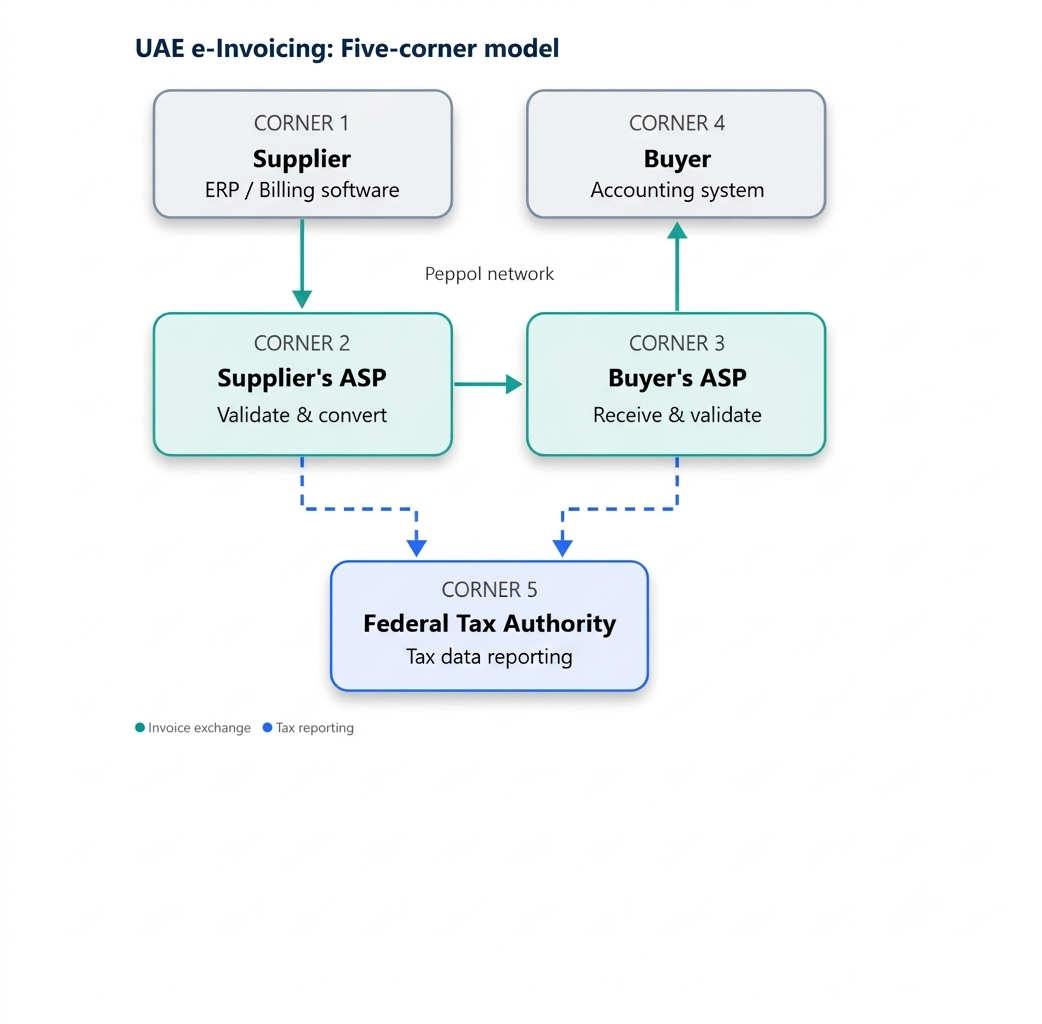
The electronic invoicing process typically involves five steps:
-
Invoice generation: The supplier creates invoice data using its ERP or accounting platform.
-
Invoice validation: The supplier's ASP checks the information and converts it into the required structured format where necessary.
-
Invoice transmission: The electronic invoice is exchanged with the buyer's ASP through the Peppol network.
-
Invoice delivery: The buyer's ASP processes and delivers the invoice to the buyer.
-
Tax reporting: Prescribed invoice tax data is reported to the FTA through the applicable reporting process.
This framework supports interoperability between different business applications without requiring every organisation to use the same accounting software.
What are the mandatory e-Invoicing requirements in the UAE?
Businesses preparing for the UAE e-invoicing mandate must address several technical, financial and operational requirements.
1. Use a structured electronic invoice format
Electronic invoices exchanged through the UAE system must comply with the applicable PINT-AE technical specifications and structured XML format.
A PDF invoice generated from accounting software does not independently satisfy this requirement.
2. Appoint an Accredited Service Provider
Businesses must select an ASP accredited by the UAE Ministry of Finance for sending and receiving electronic invoices.
The service provider facilitates secure invoice exchange, validation and tax data reporting.
3. Complete e-invoicing onboarding
Organisations must complete the applicable onboarding procedures, including relevant steps through the FTA's EmaraTax platform and integration with their selected ASP.
4. Maintain accurate tax identification details
Businesses must ensure that their Tax Identification Number (TIN), Tax Registration Number (TRN), legal entity details and other required information are accurate.
5. Follow invoice issuance deadlines
VAT-registered businesses must follow the timelines prescribed under UAE VAT legislation.
For non-VAT-registered issuers, the updated electronic invoicing rules generally require transmission within 14 business days of the relevant business transaction date.
6. Maintain electronic records
Electronic invoices, credit notes and associated transaction records must be retained for the statutory period prescribed under UAE tax legislation and remain accessible to the FTA.
7. Support invoice corrections
Businesses must have processes for managing electronic credit notes, invoice errors, cancellations and financial adjustments.
tax.gov.ae+4
Mandatory fields required in a UAE electronic invoice
The UAE electronic invoicing framework requires specific invoice information to support accurate transaction processing and tax reporting.
The following table summarises key data categories.
|
Data category |
Required information, where applicable |
|---|---|
|
Supplier details |
Legal name, address and tax identification |
|
Customer details |
Legal name, address and applicable tax identifiers |
|
Invoice information |
Invoice number, issue date and document type |
|
Product or service details |
Description, quantity and unit price |
|
Tax details |
VAT category, tax rate and tax amount |
|
Invoice currency |
Applicable currency code |
|
Financial information |
Net amount, discounts, taxes and invoice total |
|
Electronic identification |
Applicable electronic addressing information |
|
Credit note references |
Original invoice reference where required |
|
Payment information |
Relevant payment details and terms |
The exact mandatory and conditional fields vary according to the invoice type and transaction. Businesses should use the latest UAE electronic invoice mandatory field requirements when configuring their software.
Types of electronic invoices in the UAE
Businesses may need to support different electronic document types depending on the transaction and its VAT treatment.
|
Electronic document |
Purpose |
|---|---|
|
Electronic tax invoice |
Documents transactions requiring a VAT tax invoice |
|
Commercial electronic invoice |
Records relevant transactions where a tax invoice is not required |
|
Electronic tax credit note |
Adjusts the VAT treatment or value of an earlier tax invoice |
|
Electronic credit note |
Corrects or adjusts an applicable commercial invoice |
|
Self-billed electronic invoice |
Allows buyer-generated invoices under permitted self-billing arrangements |
|
Self-billed electronic credit note |
Adjusts an eligible self-billed transaction |
Accounting and ERP systems should support all document types relevant to the organisation's business activities.
What is an Accredited Service Provider (ASP) in UAE e-Invoicing?
An Accredited Service Provider is an organisation authorised under the UAE electronic invoicing framework to facilitate compliant electronic invoice exchange and reporting.
The ASP acts as a technical intermediary between businesses, their trading partners and the tax reporting infrastructure.
How to choose the right e-Invoicing service provider in the UAE
Before selecting an ASP, businesses should evaluate its official accreditation status, compatibility with existing ERP and accounting software, invoice processing capabilities, cybersecurity controls, scalability, technical support and pricing.
Businesses using SAP, Oracle, Microsoft Dynamics, Odoo, Tally, Zoho Books or custom ERP systems should also confirm that their proposed provider supports the necessary integration.
Under Ministerial Decision No. 168 of 2026, the Ministry of Finance introduced an updated accreditation framework for electronic invoicing service providers.
Always verify your provider's current accreditation status through the official Ministry of Finance e-invoicing portal before entering into an agreement.
United Arab Emirates+1
UAE e-Invoicing penalties and fines in 2026–2027
Failure to comply with mandatory electronic invoicing requirements may result in administrative penalties.
Cabinet Decision No. 173 of 2026 replaces the earlier penalty framework under Cabinet Decision No. 106 of 2025.
|
Violation |
Administrative penalty |
|---|---|
|
Failure to implement e-invoicing or appoint an ASP on time, and certain ongoing recipient compliance failures |
AED 5,000 initially, followed by AED 5,000 for each month or part-month of continuing non-compliance |
|
Failure to issue and transmit an electronic invoice |
AED 100 per invoice, capped at AED 5,000 per calendar month |
|
Failure to issue and transmit an electronic credit note |
AED 100 per credit note, capped at AED 5,000 per calendar month |
|
Failure to notify the ASP of changes to FTA-registered information |
AED 250 per day or part-day, capped at AED 5,000 per calendar month |
The aggregate penalty for specified implementation and recipient compliance violations is capped at AED 50,000 over any 12 consecutive months.
The updated regulations also removed the previous penalty for failing to notify the FTA of a system failure.
????? ??????? - ???????? ??????? ???????+1
Businesses should establish internal compliance monitoring procedures to identify and resolve invoicing issues before they result in regulatory violations.
Traditional invoicing vs e-Invoicing in UAE
Electronic invoicing introduces significant changes to how businesses generate, process and manage financial documents.
|
Feature |
Traditional invoicing |
UAE e-Invoicing |
|---|---|---|
|
Invoice format |
Paper, PDF or Excel |
Structured electronic data |
|
Data processing |
Often manual |
Automated processing possible |
|
Invoice exchange |
Email or physical delivery |
Accredited electronic network |
|
Validation |
Manual or internal checks |
Structured technical validation |
|
Tax reporting |
Separate tax reporting workflows |
Integrated invoice tax data reporting |
|
ERP integration |
Optional |
Integration or compatible workflow recommended |
|
Error detection |
Often after processing |
Earlier identification of validation errors |
|
Record management |
Physical or digital files |
Electronic records and audit trails |
Unlike traditional digital invoicing, the UAE framework creates a standardised environment for invoice exchange and tax reporting.
Benefits of e-Invoicing for UAE businesses
Beyond regulatory compliance, adopting electronic invoicing can improve financial operations across an organisation.
Improved VAT compliance
Structured tax information can help businesses reduce reporting discrepancies and maintain more consistent transaction records.
Reduced operational costs
Automated invoice processing can reduce manual data entry, printing, document handling and administrative workloads.
Faster invoice processing
Electronic invoice delivery can accelerate approval workflows and reduce payment delays caused by missing or inaccurate invoice information.
Better financial visibility
Integration with ERP and accounting platforms can provide improved visibility into accounts payable, accounts receivable and invoice statuses.
Enhanced data accuracy
Standardised validation rules can identify incomplete or inconsistent information before invoices progress through the workflow.
Improved audit readiness
Accessible electronic records and transaction histories can simplify financial audits and tax compliance reviews.
The extent of these benefits depends on the quality of implementation, system integration and internal business processes.
How to prepare your business for UAE e-Invoicing
Preparing for the UAE e-invoicing deadline requires more than purchasing new software. Businesses should develop a structured implementation strategy involving their finance, taxation, operations and IT teams.
Step 1: Determine your compliance deadline
Review your business revenue, transaction categories and applicable regulatory requirements to identify your implementation phase.
Step 2: Audit your existing invoicing process
Assess how your organisation currently creates, sends, receives, corrects and stores invoices.
Identify any manual workflows that could create compliance gaps.
Step 3: Select an accredited service provider
Compare officially accredited providers based on their technical capabilities, industry experience, integration options and ongoing support.
Step 4: Upgrade your accounting or ERP software
Ensure your existing software can provide the data necessary for structured electronic invoices, credit notes and transaction reporting.
Step 5: Clean customer and supplier data
Verify business names, addresses, tax identifiers, VAT classifications, currency codes and other relevant master data.
Step 6: Integrate and test the system
Conduct end-to-end testing covering invoice creation, validation, transmission, receipt, error handling and credit note processing.
Step 7: Train finance and operations teams
Ensure employees understand electronic invoicing requirements, exception management, compliance deadlines and updated workflows.
Step 8: Monitor compliance after implementation
Establish a process for tracking invoice failures, reviewing system performance, maintaining records and responding to regulatory changes.
UAE e-Invoicing readiness checklist
Use this checklist to evaluate whether your business is prepared for mandatory electronic invoicing.
Business compliance readiness
- 0 of 12 preparation tasks completed
- Identify the applicable implementation deadline
- Review B2B, B2G and B2C transactions
- Appoint an accredited service provider
- Complete applicable EmaraTax onboarding
- Verify ERP and accounting software compatibility
- Validate customer and supplier master data
- Map mandatory PINT-AE invoice fields
- Test electronic invoice and credit note exchange
- Establish secure electronic record retention
- Train finance, operations and IT teams
- Define invoice error and exception procedures
- Complete end-to-end testing before go-live
- Copy readiness checklist
UAE e-Invoicing compliance examples
Example 1: Large company in Dubai
A construction materials supplier generates annual revenue of AED 75 million and supplies products to other businesses.
Its ASP appointment deadline was 30 October 2026, and mandatory implementation begins on 1 January 2027.
The company must ensure its invoicing and procurement systems support the electronic exchange of relevant invoices.
Example 2: SME in Abu Dhabi
A professional consulting company generates annual revenue of AED 8 million.
It must appoint an ASP by 31 March 2027 and implement electronic invoicing by 1 July 2027 for its in-scope transactions.
Example 3: Retail business in Sharjah
A retail store primarily sells products to individual customers.
Although its B2C sales are currently outside the mandate, it may still have electronic invoicing obligations relating to purchases from business suppliers.
These examples are illustrative and assume no specific regulatory exclusions apply.
Common e-Invoicing mistakes businesses should avoid
Many organisations may underestimate the technical and operational changes required for electronic invoicing.
Common mistakes include treating PDF invoices as compliant e-invoices, assuming non-VAT-registered businesses are automatically exempt, overlooking incoming supplier invoices, selecting an unaccredited provider, ignoring customer master data quality and delaying ERP integration until the implementation deadline.
Businesses should also avoid relying on outdated penalty information or assuming that free zone status automatically removes their compliance obligations.
Early preparation and regular compliance reviews can reduce implementation risks.
How to choose the best e-Invoicing software in the UAE
When evaluating electronic invoicing software, businesses should look beyond basic invoice generation functionality.
An effective solution should support:
-
Integration with accredited service providers.
-
Peppol PINT-AE compatibility.
-
ERP and accounting software integration.
-
Electronic invoice and credit note management.
-
Automated data validation.
-
Invoice status tracking and error notifications.
-
Multi-company and multi-currency operations where required.
-
Secure document management and audit trails.
-
Scalability and ongoing regulatory updates.
The right e-invoicing software should meet your current compliance obligations while supporting future business growth and financial automation.
Frequently asked questions about e-Invoicing in UAE
1. Is e-Invoicing mandatory in the UAE in 2026?
The pilot and voluntary implementation phase began on 1 July 2026. Mandatory operational implementation begins on 1 January 2027 for in-scope businesses with annual revenue of AED 50 million or more.
However, these businesses were required to appoint an Accredited Service Provider by 30 October 2026.
2. What is the e-Invoicing deadline in the UAE?
The mandatory UAE e-invoicing deadlines are:
-
1 January 2027 for businesses with revenue of AED 50 million or more.
-
1 July 2027 for businesses with revenue below AED 50 million.
-
1 October 2027 for in-scope government entities.
3. Is e-Invoicing mandatory for small businesses in the UAE?
Yes. Small businesses undertaking in-scope transactions must generally appoint an ASP by 31 March 2027 and implement electronic invoicing by 1 July 2027.
4. Are PDF invoices considered electronic invoices in the UAE?
No. PDF invoices, scanned documents and emailed invoice attachments do not independently qualify as compliant electronic invoices. The UAE framework requires structured, machine-readable invoice data.
5. What is the role of the FTA in UAE e-Invoicing?
The Federal Tax Authority receives prescribed electronic invoice tax data, supports onboarding and tax compliance processes, and administers applicable regulatory obligations and penalties.
6. Is e-Invoicing mandatory for non-VAT-registered businesses?
Yes, where their transactions fall within the electronic invoicing framework. VAT registration status alone does not determine whether a business is subject to the mandate.
7. What is Peppol in UAE e-Invoicing?
Peppol is an international interoperability framework that enables businesses and public organisations to exchange standardised electronic documents through a secure network.
The UAE uses the PINT-AE specification within its Peppol-based e-invoicing framework.
8. Is e-Invoicing mandatory for UAE free zone companies?
Free zone companies may be subject to mandatory electronic invoicing if they undertake in-scope transactions. Operating within a free zone does not automatically provide an exemption.
9. What are the penalties for not implementing e-Invoicing in the UAE?
Specified implementation violations can attract an initial AED 5,000 penalty and further monthly penalties of AED 5,000, subject to an aggregate cap of AED 50,000 within 12 consecutive months.
Other violations may attract separate penalties.
10. Can businesses implement UAE e-Invoicing before their mandatory deadline?
Yes. Voluntary implementation has been available since 1 July 2026, subject to the applicable technical requirements.
11. Is e-Invoicing mandatory for B2C transactions in the UAE?
B2C sales are currently outside the mandatory electronic invoicing framework. However, businesses making B2C sales may still need to receive electronic invoices for their B2B purchases.
12. Can businesses use their existing ERP software for UAE e-Invoicing?
Yes. Businesses can continue using their existing ERP or accounting platforms, provided the software and associated workflows can integrate with an accredited service provider and meet applicable electronic invoicing requirements.
13. What is the difference between a TIN and TRN in UAE e-Invoicing?
A TIN is a 10-digit Tax Identification Number. It corresponds to the first ten digits of the 15-digit Tax Registration Number issued by the FTA.
14. Do UAE electronic invoices need to be stored within the UAE?
The October 2026 regulatory amendments removed the specific domestic storage requirement under the electronic invoicing framework.
Businesses must still retain their electronic records for the applicable statutory period and make them available to the FTA upon request.
15. How is business revenue calculated for UAE e-Invoicing deadlines?
Revenue generally refers to gross income during the most recent accounting period, supported by financial statements or other documentation acceptable to the FTA. It is not simply the business's net profit.
16. What should businesses do if they missed the ASP appointment deadline?
Affected businesses should urgently appoint an accredited provider, assess their compliance position, complete onboarding and seek qualified tax advice regarding potential penalties and corrective actions.
Conclusion
The introduction of e-invoicing in the UAE represents an important development in the country's digital taxation and financial transformation strategy.
With mandatory implementation beginning in January 2027, businesses must proactively assess their compliance obligations, select accredited service providers, integrate their accounting systems and establish reliable electronic invoicing processes.
Early adoption can help organisations minimise regulatory risks, improve financial accuracy and streamline invoice management.
Whether your business operates in Dubai, Abu Dhabi, Sharjah or another emirate, preparing for UAE electronic invoicing today can support a smoother transition to mandatory digital compliance.
Is your business ready for UAE e-Invoicing? Review your existing accounting infrastructure, assess your implementation deadline and consult a qualified e-invoicing specialist to develop a compliance-ready strategy.
Disclaimer: This article is provided for general informational purposes and does not constitute professional tax or legal advice. Businesses should consult the latest Ministry of Finance regulations and qualified UAE tax professionals regarding their specific obligations.